Prof. Ulf Leonhardt
Bending light with the geometry of curved space — from invisibility cloaks to laboratory event horizons
Research
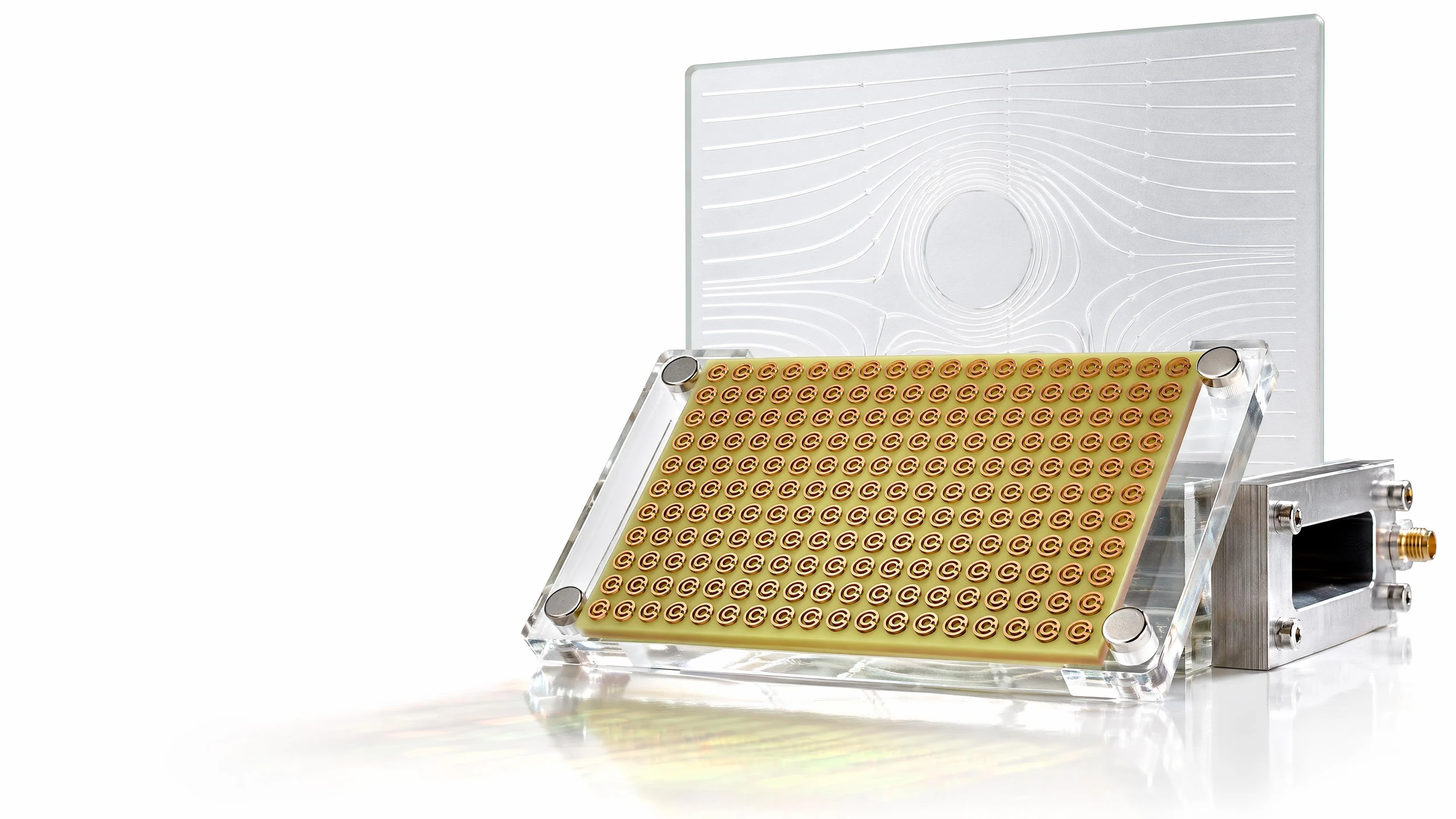
The group studies how light propagates through structured and moving media by treating optics in the language of curved spacetime geometry. Maxwell's equations in a dielectric can be recast as wave propagation in an effective metric, which means that engineered materials can be designed to make light follow prescribed trajectories. This perspective underlies transformation optics, where coordinate transformations are translated into spatial profiles of permittivity and permeability, and it provides the conceptual basis for invisibility devices and other instruments that steer light along curved paths.
The same geometric framework connects optics to gravitation and to the quantum vacuum. Flowing media and strong dispersion can mimic the horizon of a black hole, allowing aspects of Hawking radiation and related horizon physics to be examined in a controlled optical setting. Closely related questions concern the Casimir force and the energy of the electromagnetic vacuum in inhomogeneous media, where the geometry of the dielectric environment determines the forces between bodies. Together these directions test how classical geometry, electromagnetism, and quantum fluctuations intertwine.
Group members
The named roster for each group is generated from the People directory, filtered by this group.
Selected publications
Representative papers from the group — the full record is drawn from ORCID & Google Scholar.
Representative selection — browse the full department list on the Publications page.