Prof. Ofer Feinerman
How thousands of ants without a leader pool sensing, memory, and muscle into one decision-making whole
Research
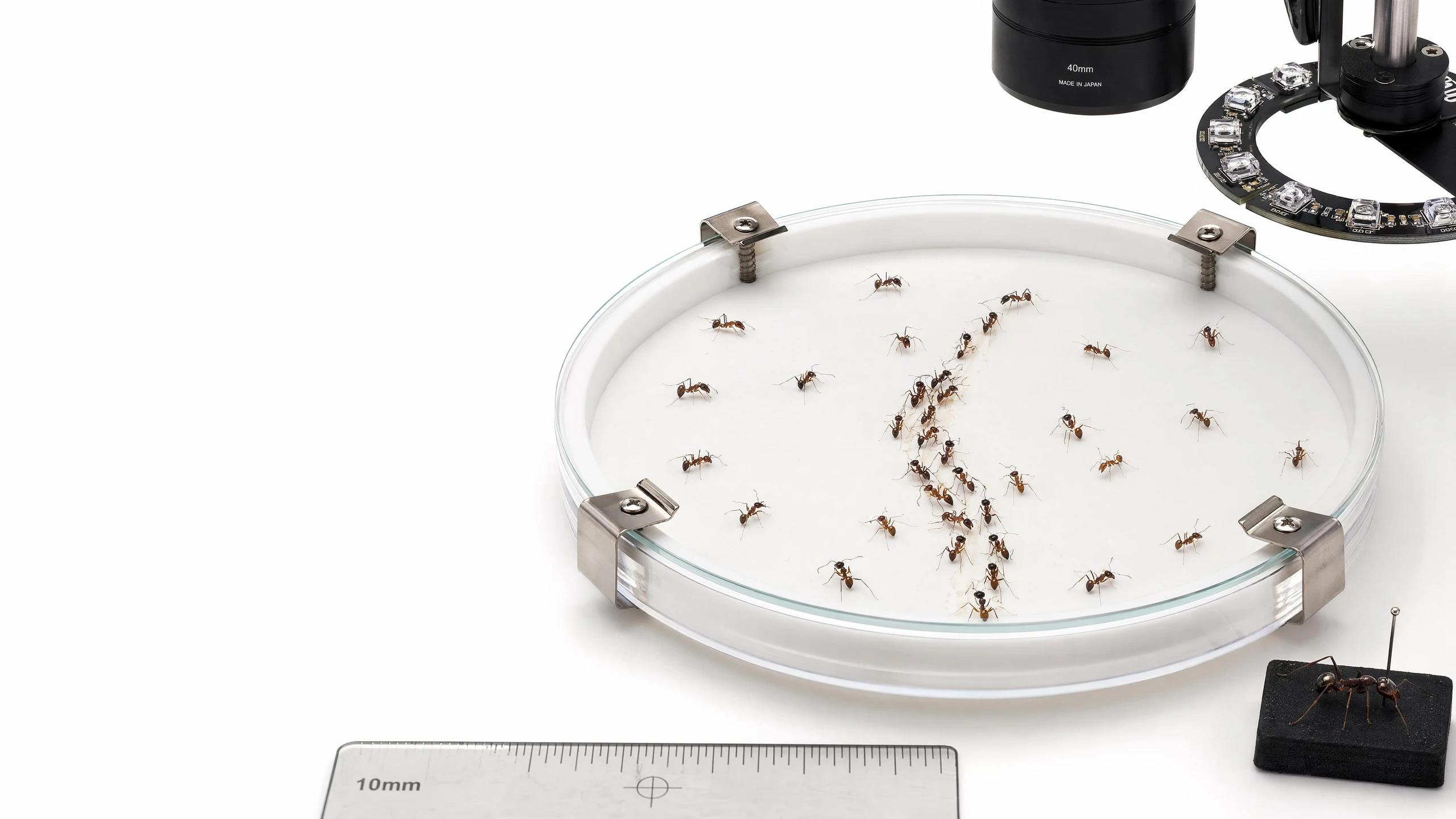
The group studies how cooperation emerges in social insects, using longhorn crazy ants and their cooperative load transport as a tractable model for collective computation. By tracking individual ants while they jointly carry food far too large for any one of them, the work asks how local mechanical and chemical interactions, without central control, give rise to coordinated motion, shared navigation, and group-level decisions. The questions sit at the interface of statistical physics and biology: when does a crowd of limited agents behave as a single cognitive unit, and how is information distributed across the bodies that compose it.
This matters because collective behavior is a general route by which biological systems solve problems that exceed individual capacity, from cells in tissues to neurons in brains. Treating the ant group as a physical system, the group quantifies how individuals balance personal information against conformity, how transient leaders inject correction without disrupting consensus, and how the group navigates and recovers from errors. The results illuminate the limits and advantages of decentralized computation and connect measurable animal behavior to broader theory on emergent intelligence.
Group members
The named roster for each group is generated from the People directory, filtered by this group.
Selected publications
Representative papers from the group — the full record is drawn from ORCID & Google Scholar.
Representative selection — browse the full department list on the Publications page.